

Originally published on 2021-12-10.
#Natural Law has been known by humans since time immemorial. We know this becuase it is expressed in one way or another in all of the major cultures and religions.
In the west it is best known as the Golden Rule, or Gods Rule:
“Do unto others as you would have done to yourself.”
For some it becomes more clear when expressed in the negative:
“Do NOT do unto others as you would NOT have done to yourself.”
St. Thomas Aquinas believed in the objective order of nature. After his work on proving the existence of God, he is probably most famous for his understanding of natural law. While Aquinas believed that this objective order of nature (and the operation of human reason which discovers it) are, in fact, ultimately grounded and established by God’s intelligent willing of the good of creation (i.e., His love), he recognizes that one does not need to know that the objective order of nature was God’s creation. Thus, whether or not one believes in or rationally proves there is a God, one can recognize, and be bound by natural law. According to Aquinas, it applies to all people at all times, and in some sense is known by all rational humans (though, of course, they do not (but should) always act in accordance with it).
Aquinas distinguishes four kinds of laws:
-
Eternal law is comprised of those laws that govern the nature of an eternal universe
-
Divine law is concerned with those standards that must be satisfied be a human being to achieve eternal salvation
-
Natural law is comprised of those precepts of the eternal law that govern the behavior of beings possessing reason and free will
-
Human law is (that which is promalgated by human beings) valid only insofar as its content conforms to the content of Natural Law
Eternal law is comprised of those laws that govern the nature of an eternal universe. Divine law is concerned with those standards that must be satisfied be a human being to achieve eternal salvation. Natural law is comprised of those precepts of the eternal law that govern the behavior of beings possessing reason and free will. Human law is (that which is promalgated by human beings) valid only insofar as its content conforms to the content of Natural Law. As Aquinas puts it:
“Every human law has just so much of the nature of law as is derived from the law of nature. But if in any point it deflects from the law of nature, it is no longer a law but a perversion of the law” (ST I-II, Q.95, A. II).
To paraphrase, an unjust law is really no law at all.
Dr. Martin Luther King, Jr. made reference to to this in one of his letters:
“I would be the first to advocate obeying just laws. One has not only a legal but a moral responsibility to obey just laws. Conversely, one has a moral responsibility to disobey unjust laws. I would agree with St. Augustine that “an unjust law is no law at all.” Now, what is the difference between the two? How does one determine whether a law is just or unjust? A just law is a man made code that squares with the moral law or the law of God. An unjust law is a code that is out of harmony with the moral law. To put it in terms of St. Thomas Aquinas: An unjust law is a human law that is not rooted in eternal law and natural law. Any law that uplifts human personality is just. Any law that degrades human personality is unjust. All segregation statutes are unjust because segregation distorts the soul and damages the personality. It gives the segregator a false sense of superiority and the segregated a false sense of inferiority.”
To truly know natural law is to know what actions we do NOT have a right to do because taking them is harming another being.
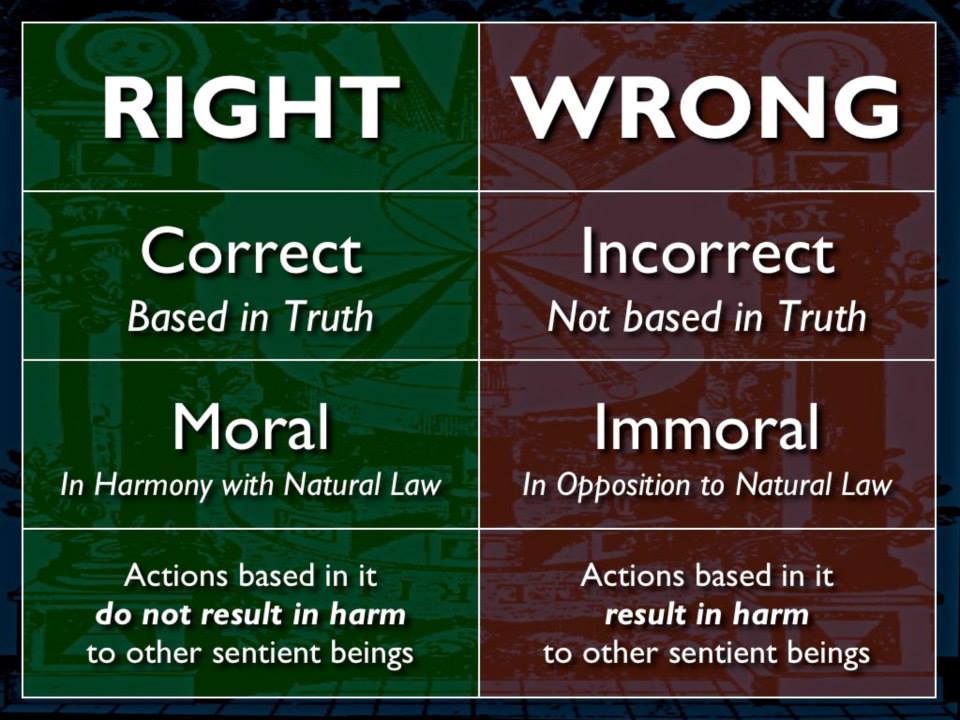
The above post was adapted from a talk given by Mark Passio. If you found this article interesting and would like to share a comment with me, feel free to get in touch.
Comments
Join the discussion. Be thoughtful, stay on topic, and treat other readers as neighbors. Email sign-in and comment data are described on the privacy page.