
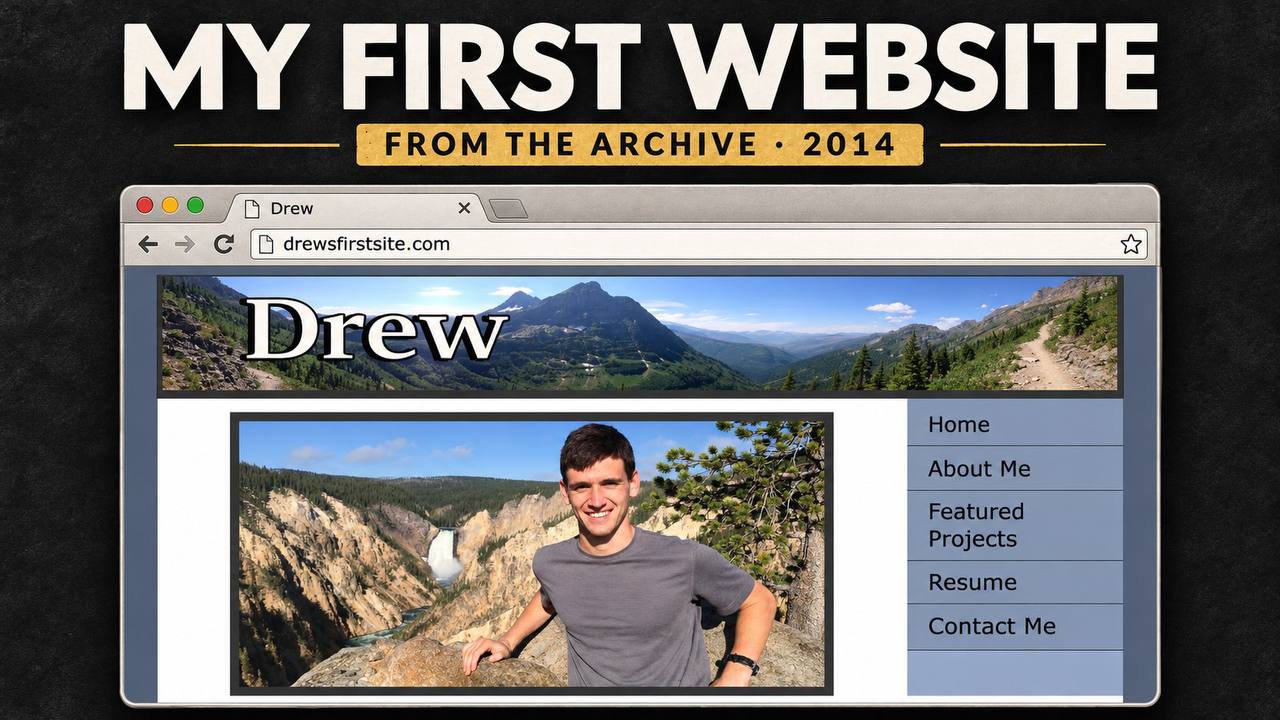
There’s something I didn’t mention in my article about my first website: it had a blog page. The page didn’t work. It was hidden and never appeared as one of the real pages, but the intention was there. I wanted a space to write.
A few months later, I found one. Shortly after I finished my geology degree, I moved to Oklahoma to work on oil rigs, and there I started a little Blogger site that became my Star Log.
Read the Star Log, still online as it was in 2014 →
The blog that doesn’t count #
I knew about blogs because of high school. I went to a fairly progressive private school, and during my junior year (I think) my English teacher made us all open Blogger accounts. We posted our essays there, and he graded the blogs.
I don’t remember making much of that opportunity, or understanding what it meant to have your own space online to express yourself. It was homework. So I don’t count it as my first blog.
But I remembered it. In Oklahoma, I wanted my writing to find some kind of audience, or at least be out in public, and that old assignment came to mind. So instead of building out the blog page on my personal website, I made another Blogger account.
Nights at the edge of the light #
I called it the Star Log because I worked nights in the middle of nowhere, and the stars were good.
The rigs themselves were flooded with light. But if you walked to the edge of the dome of light around the rig, the stars were pretty good, and past it they were great. I was in the middle of Oklahoma and spent most of my time around Lindsay, and I started learning the sky.
I was reading a lot of science fiction then, too. I’d gotten a Kindle, downloaded a list of Hugo Award winners, and started checking them off. Between 2014 and 2015 I read something like 35 science fiction books. I was very much in a science-and-science-fiction headspace, and I especially loved fiction that made real use of science. The Martian came out around then, and I remember reading the whole thing in about a day.
Depending on how fast the drilling was going, night shifts could leave a lot of downtime, for reading and for looking up. I wanted to get to know the sky, so I bought a pair of astronomy binoculars. Then I bought a giant pair of astronomy binoculars.
From binoculars to a camera #
I got into photography around the same time. I knew that after my year on the rigs, my then-girlfriend (now my wife) and I would spend a month or so traveling around Europe, and I wanted to come back with good photographs. I bought my first DSLR and several lenses.
Since I was already looking at the sky, astrophotography came next. I never connected the camera to a telescope, but I had a telephoto lens that could reach a few things up there. I got some pretty good pictures of the Moon, and I photographed the Pleiades, the Andromeda Galaxy, and Orion.
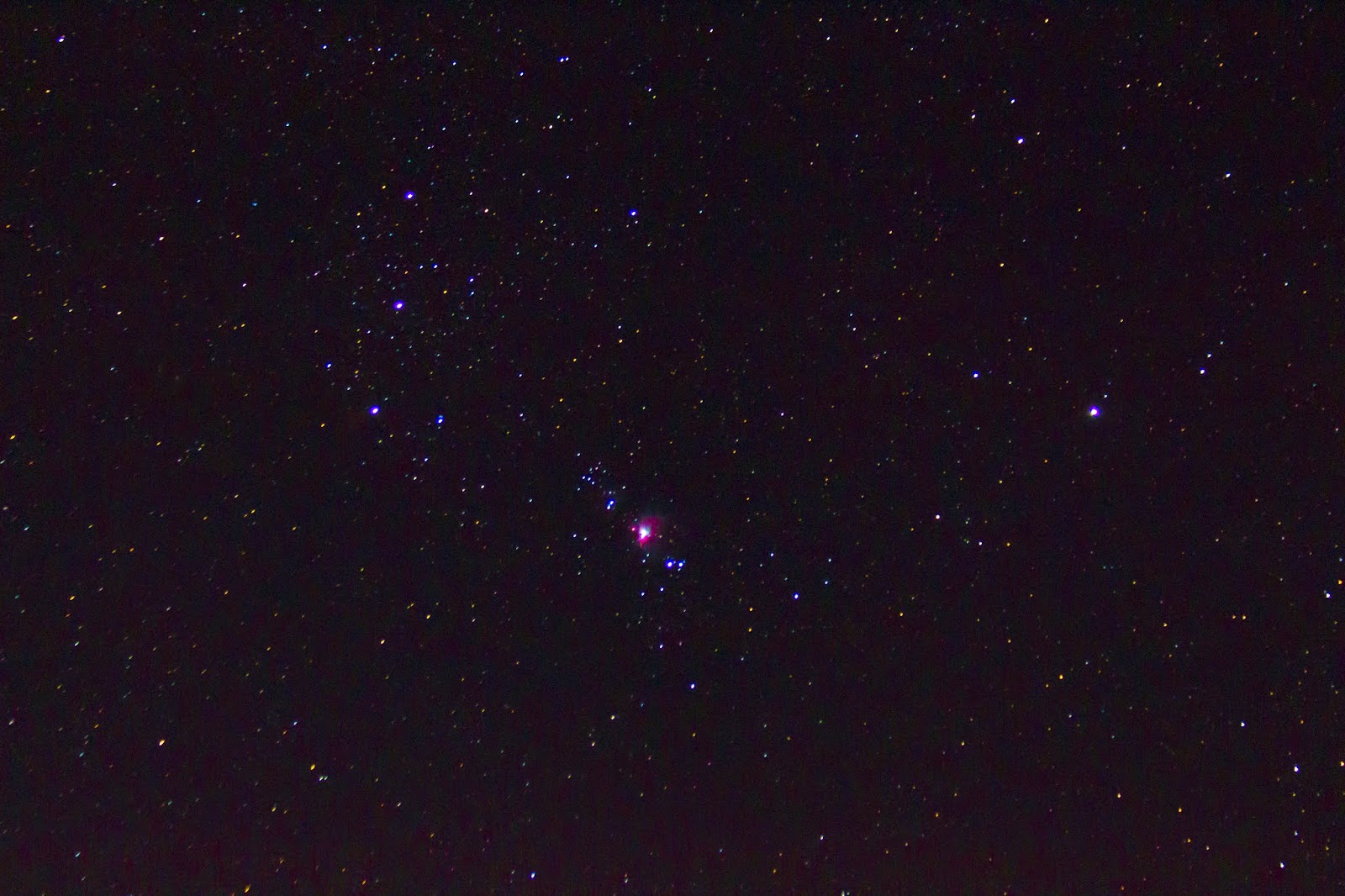
From the Star Log: the Orion Nebula, shot with a DSLR and a telephoto lens, no telescope.
What I wrote #
Those nights became Star Log posts. I wrote four in all, between September and December 2014:
- A Short Break in the Clouds (September 17, 2014): a gap in the clouds, the big binoculars, and Orion’s Belt, the Orion Nebula, the Moon, and Jupiter with four of its moons.
- Full Lunar Eclipse (October 8, 2014): watching a total lunar eclipse, and why the Moon turns red.
- Photographing the Moon (December 8, 2014): how I shot the Moon with a DSLR, from settings and focus to editing the raw file.
- Orion & The Seven Sisters (December 25, 2014): the Orion Nebula and the Pleiades, photographed on Christmas night.
Four posts, because I was coming straight out of a geology degree and still wrote everything like a detailed report. I went all in on every post and tried to explain a real piece of science in each one. That’s a lot to keep up on top of night shifts on a rig, so the Star Log didn’t last long.
Where it clicked #
Even so, the Star Log was where it clicked for me how cool it is to express yourself outside of school.
My website was probably my first try at that idea, but it was mostly a résumé with pages. The blog let me follow a passion, share it with other people, and teach things I actually cared about. Nobody assigned it and nobody graded it.
It was my second attempt at sharing something publicly outside of social media, and it was a very good experience.
A snapshot #
I checked, and the posts are still there, so I’m linking them here for the archive.
They capture what I cared about during my first real job, a fairly lonely stretch of working and living on oil rigs in Oklahoma. They’re a snapshot of that time.
The last one is from Christmas night. It was the first time in my life I’d spent Christmas alone, and I spent it outside taking pictures of the stars, then came in and wrote a blog post about them.
That’s my Star Log.
Comments
Join the discussion. Be thoughtful, stay on topic, and treat other readers as neighbors. Email sign-in and comment data are described on the privacy page.