
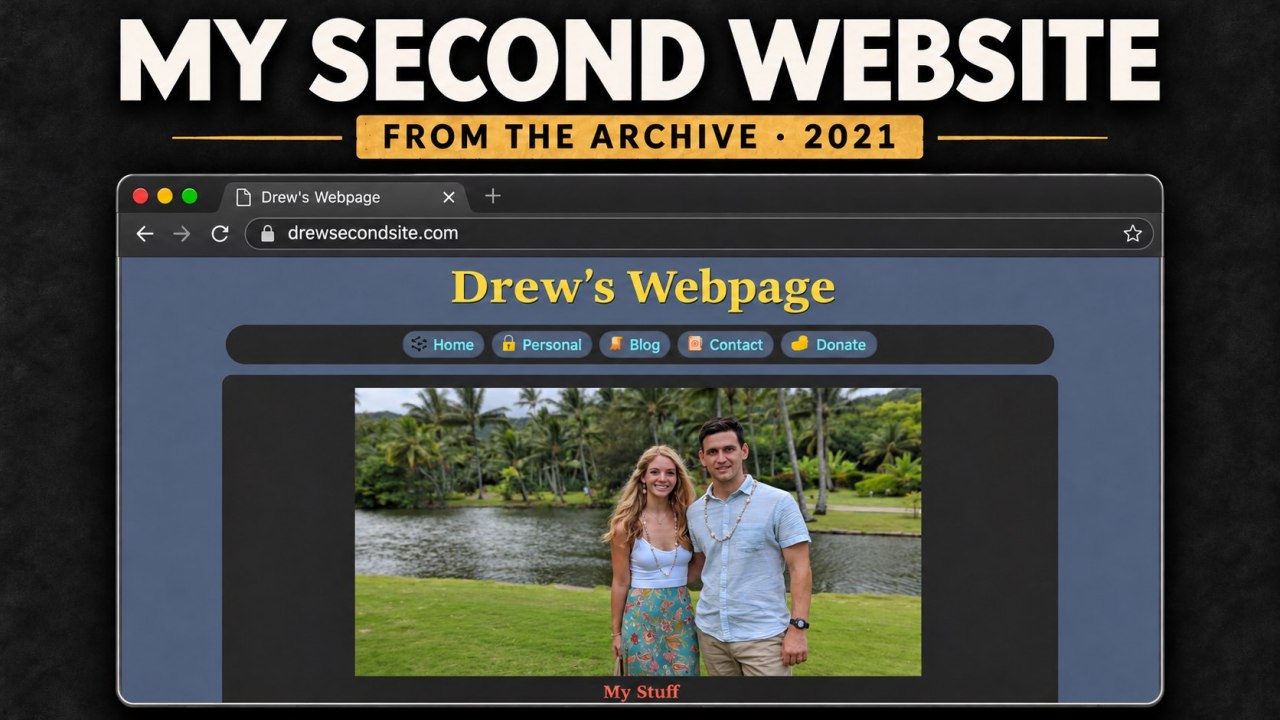
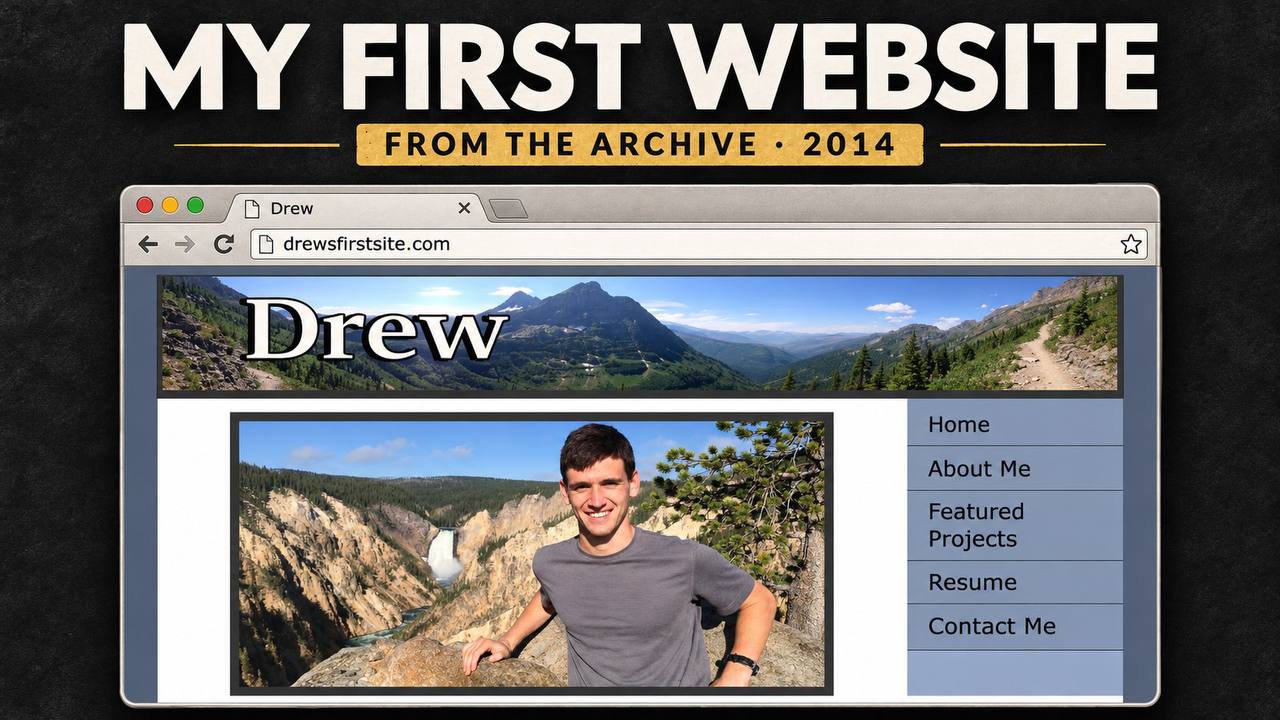
I made my first website as I was graduating with my geology degree. It was more or less part of my résumé: a place to show off my work, and a place where I might grow and express myself through a blog. Shortly after, I started my Star Log blog. Both were framed around geology and science. They were ways of funneling my interests into my career and my academic pursuits.
My second website was something different. It was the first one I truly owned.
Visit my second website, preserved as it was →
From rocks to software #
Fast forward a number of years. I left the geology field behind and went back to engineering school for a degree in computer engineering. Software was the new focus.
After I graduated, I was working in the field, and a lot of my interests had shifted to software, free software, and Linux. Around that time I was following someone on the internet named Luke Smith, enjoying his videos and learning from them.
Landchads and internet peasants #
He put out a video that was very tongue in cheek, as many of his videos are. But the point was serious: you need your own sovereign space online, and social media does not count.
This was becoming more and more relevant to me in 2021. I was starting to see the importance of balancing decentralization and centralization, in software and in really everything else. And it was right around the time you could start to see the centralized platforms pruning unwanted individuals from their services. People who had built entire careers on YouTube were getting their channels banned. Censorship on social media was on the rise, and in a very blatant way.
His argument was that you should be a “landchad,” which is a pun and a meme, instead of an internet peasant, beholden to the lords of social media for how you’re allowed to express yourself online. He sold it with a bit of shame: if you actually care about expressing yourself and having a space online, you can pay $5 a month for a server and a couple of dollars a year for a domain. Then you don’t have to worry about centralized forces censoring you. You take ownership of your digital content.
That really spoke to me.
Setting it up #
He had a video showing exactly how to do it, so I did it. This is the one I followed:
- Setting up a Website and Email Server in One Sitting (Internet Landchad) on Luke’s own PeerTube instance (January 2021)
- The same video on YouTube
I prefer the PeerTube link, because it points back to Luke’s own instance. That’s the whole idea in practice.
I got a virtual Linux server from Vultr, I got a domain name, and in 2021 I set up my website.
I was already in software, so it wasn’t difficult. It took some time, and navigating Vultr’s interface and the rest took patience, but that was the only real difficulty. His guide walked you through getting a very basic website up and running, and from there I slowly learned how to do more.
The original intent of the internet #
Part of what made Luke Smith compelling was that there was intention behind everything he did and said. He lived by a kind of creed, and at that point in his life he was trying to pursue truth to the best of his ability.
He argued that a lot of modern web development is bloated: more is going on than needs to be, and it overcomplicates things. The original intent of the internet was a decentralized network of websites. Social media undermined that by centralizing everything, so people never actually explored the internet. They stayed on one node of the network, inside a walled garden.
Take Facebook. You’ve got Facebook, you’ve got Instagram, and a lot of people just stay there. They might go over to YouTube or Google something, but they’re bouncing between two of many, many nodes. They aren’t exploring. It’s a monopolization of the internet.
That’s the danger of centralization. It’s fine while you’re allowed to express yourself freely. But once the platforms realize they have enough power that the masses won’t leave, they can start to dictate what “right speech” is, what you can and cannot say online, and they can squash you at the level of the individual.
So his point was that we shouldn’t have profiles on Facebook. We should all have individual websites. That’s good for two reasons: it puts the power back in your hands, and, more broadly, it’s how the internet was meant to work.
Just HTML and CSS #
Setting it up taught me how to manage a server a little and how to work in a virtual Linux environment, and my eyes opened to the possibilities.
The site itself was just HTML and CSS. Nothing fancy was going on at all, and the simplicity made it even better. It was extremely simple and very human-readable. It’s not really programming. And it was fast. Plain HTML and CSS is the lowest level of abstraction in web development, so the pages loaded instantly. This felt like how things were supposed to be. My webpage was snappy.
A different kind of sharing #
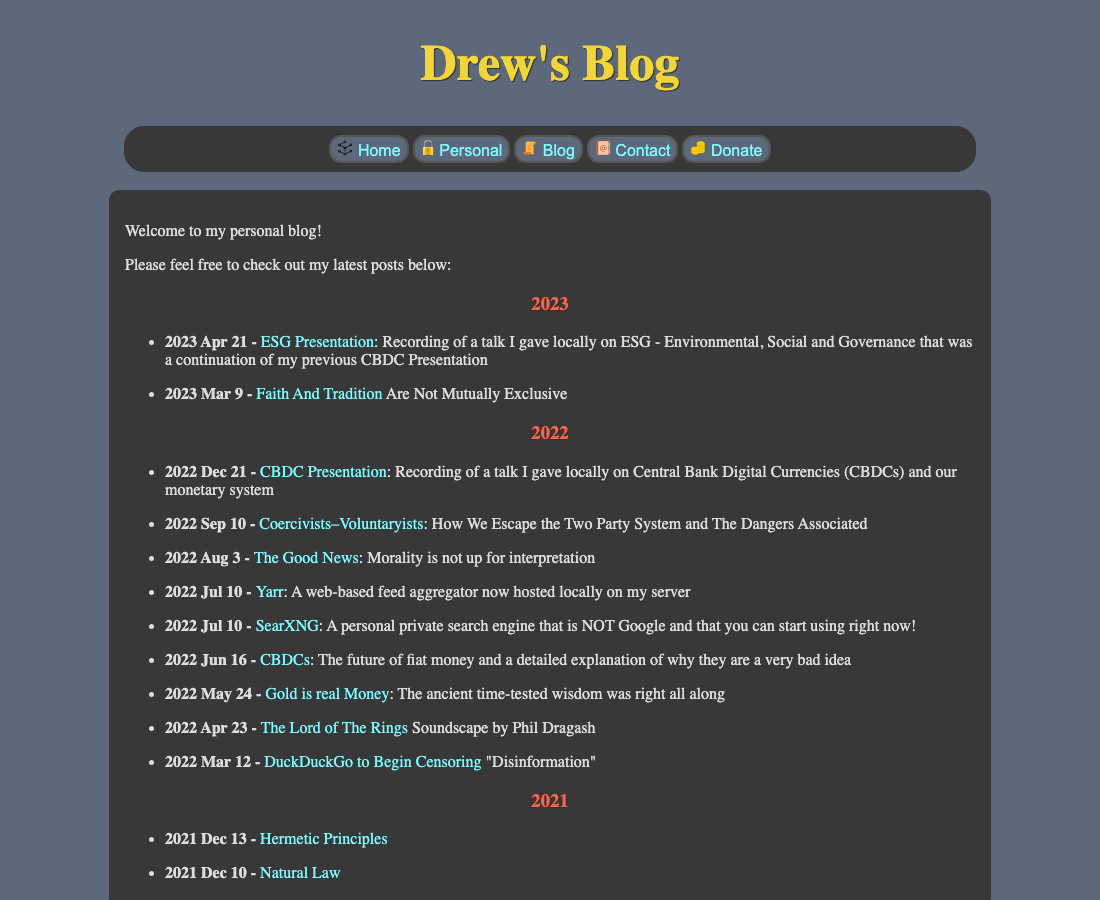
The other thing was that I could just write a blog post in HTML. I could express an idea very quickly, and because it was online, it was accessible from anywhere. I could send a post to any of my friends and family. That was revolutionary for me: I could write down my thoughts on a topic and share them with the people I cared about.
Because it was a website, it almost carried more weight. And there was no algorithm pushing my post to everybody I’d ever known in my entire life.
If you think about how we interact as humans, that’s a very unhuman way to present yourself. We have different sides of ourselves, faces we share differently depending on who we’re with. Facebook was weird because you’re putting on a face for everyone at once, so you’re very guarded in what you post. With a website, everybody I’ve ever known isn’t going to show up. That gave me the freedom to express myself more openly.
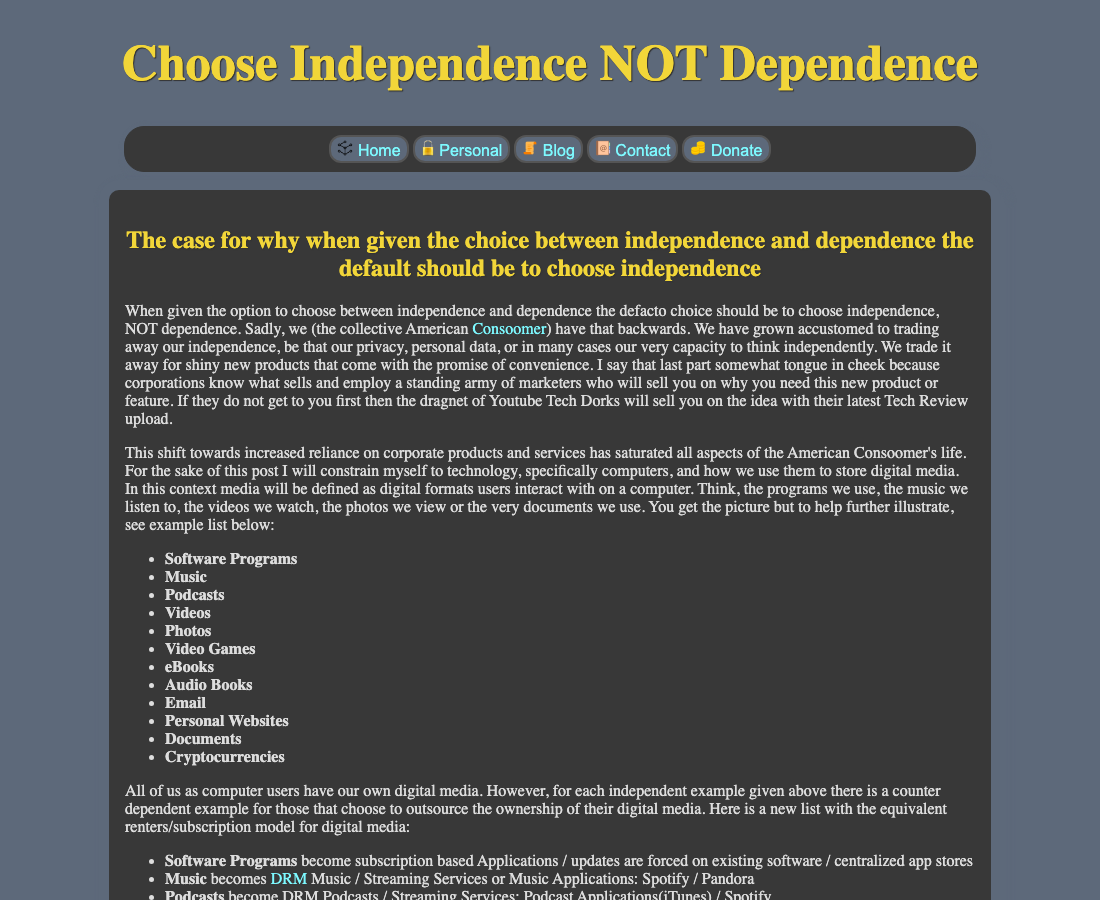
It also got me thinking critically. What do I want to write about? What do I want to share with the world? Which of my hot takes do I want to put out there? My first post, Independence Not Dependence (original), went up in August 2021, and over the next couple of years I wrote about everything from self-hosting and journaling to learning Latin, woodworking, money, and faith.
Exploring the possibilities #
Then I started exploring what else I could run on my server.
- Email: I hosted my own.
- An e-book library: my own Calibre server for my digital books.
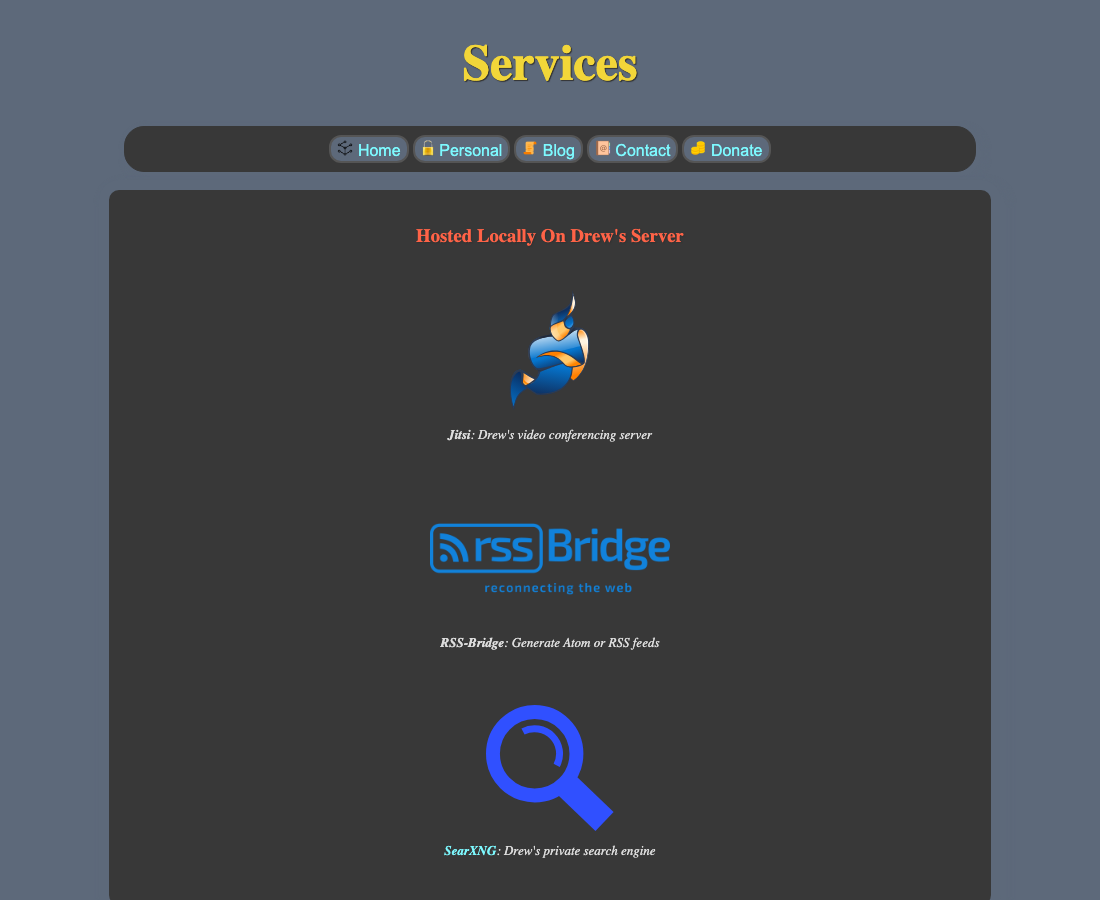
- A search engine: my own private SearXNG instance.
- Videos: my own PeerTube instance to host my videos.
- And more: a Jitsi video conferencing server, RSS-Bridge for generating feeds, and Yarr, a web-based feed reader.
I wrote up several of these on the blog as I set them up. Those posts have since moved here to The Drew Archive, but the originals are still on the preserved site, so you can read each one either way:
- Calibre: A personal library server (October 2021): read it here · original
- Jitsi: A personal video conferencing server (October 2021): read it here · original
- RSS-Bridge: Generate Atom or RSS feeds (September 2021): read it here · original
- SearXNG: A personal private search engine (July 2022): read it here · original
- Yarr: A web-based feed aggregator (July 2022): read it here · original
Most of these services are offline now, but the posts remain.
I started getting creative with the site itself, too. I set up different subdomains, and then subdomains that required a password, so I could share things with my family that I didn’t want the broader internet to see.
Realizing the possibilities #
This was the website where I started realizing what was possible. It got me thinking more philosophically about the internet: how software could be written, and how the internet should be.
It also kept my history. On its blog page, under 2013 and 2014, I linked back to my first website and my Star Log, so the site carried the earlier versions of me along with it. The Drew Archive is doing that same work now, just with more intention.
Comments
Join the discussion. Be thoughtful, stay on topic, and treat other readers as neighbors. Email sign-in and comment data are described on the privacy page.